































The crowdfunding phenomenon has done a lot of great things for music lately, as regularly reported in Tone Deaf’s Crowfunding Forecast column.
Sites such as Kickstarter, Pozible, PledgeMusic, IndieGoGo, and more are helping to realise goals by musicians by linking them directly with their fanbase, creating a two-way exchange where the fans get to directly support the artists and projects they’re passionate about (and getting some sweet swag to boot), while the artists and musicians get to realise their projects that would be previously seen as unattainable.
From as straightforward as using funds to back touring ventures or the creation of a new album, as Eskimo Joe famously did to record-breaking success in February, to helping realise ideas that would be seen as commercially unviable, such as Slash’s horror movie soundtrack or a videogame music festival, crowdfunding has made some pretty cool yet lofty dreams a reality.
As rewarding as the end result can be for both artist and financial pledger however, not every end-goal is a raging success of Amanda Palmer proportions. While there are just as many, if not more, projects that never reach their financial goals (meaning the money is returned to backers), what happens when a project reaches its target – from the hard-earned of financial backers and hopeful pledgers – only for that end project never to materialise?
That’s precisely the case that marred a Kickstarter campaign to continue the publication of Da Capo’s popular Best Music Writing series. The popular annual series, which was founded in 2000, gathered the year’s best music journalism into one place before it folded in 2011, but Daphne Carr – a long-time editor and celebrated music writer – took the idea to revive Best Music Writing through the foundation of a new music publishing house called Feedback Press.
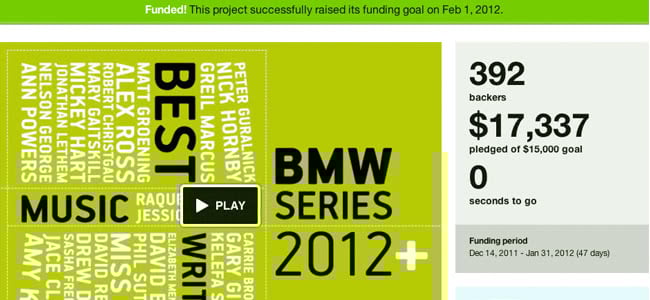
So far, so good idea, but as Noisey revealed in a detailed report on the venture, the crowdfunded, 2012 edition of Best Music Writing was never published. The Kickstarter campaign was a resounding success, raising $17,337 for the Feedback Press published tome (guest edite by Questlove of the Roots no less) on January 31st 2012, but the scheduled release date came and went with no sign of the book.
In an alarming sign, the Facebook and Twitter accounts that were updating backers on the status of Best Music Writing 2012 fell silent, while the website was abandoned and all correspondence with Daphne Carr seemingly severed, leaving many to face what they didn’t want to believe: that she’d up and run with the money.
Love Music?
Get your daily dose of metal, rock, indie, pop, and everything else in between.

Comments from the Best Music Writing Kickstarter campaign page
Most backers to the project were like New York Magazine contributing editor and previous Best Music Writing 2011 writer, Joe Hagan, donating up to around $30 on the Kickstarter campaign. “I think I pledged $25,” he told Noisey. “So, I’m not among the most highly aggrieved if it all fell through and she ran off to Honduras.” But some backers would have been, after one spent a top tier of $1,000 on the project, and another grand was shared by two pledgers who donated $500 or more each. all correspondence with [the project creator] seemingly severed, leaving many to face what they didn’t want to believe: that she’d up and run with the money.
Two of the absent Carr’s staff at Feedback Press, Tobais Carroll and Jonathan Bernstein, were left holding the proverbial bag, equally in the dark about the status of the book and any way to communicate with Carr after the glow of the Kickstarter triumph had dimmed. “This Feedback Press independent project seems to be dead,” said Bernstein. “There’s zero trust with Feedback Press now that there have been no updates in over a year.”
Meanwhile Carroll, who was administering the spiralling web of queries and angry demands over on the project’s Facebook page, noted her frustration at being “unable to do too much to respond… I do not have access to any of the funds that were raised, and I’ve been reluctant to become the public face of the project if I’m not able to report on what the status of the book is.”
Following the Noisey report, an update surfaced noting that Carr had officially cancelled the publication of the Best Writing Series project and would be refunding all backers “out of my own pocket,” says Carr. Good news, until the small caveat in her official statement that reads: “I have done the number crunching and given my current revenue streams it should take about three years of monthly payments to backers. I apologize for this long duration between your donation and my return and promise to do what I can to get it done as quickly as possible.”
Luckily, through a combination of guilt and media attention, the status of the aborted project reached its conclusion even after more than a year. But another Kickstarter project, a doco on the rise and fall of the Tower Records chain by Tom Hanks’ son Colin (yes that Tom Hanks), raised an even more astronomical feature and has held out on delivery for even longer.
Hanks successfully raised just over $92,000 from more than 16,000 backers (with at least six pledging $2,000 each) back in July, 2011, two years later and the project is apparently not much closer to completion, as Digital Music News reports.
Comments from the All Things Must Pass: The Rise And Fall of Tower Records Kickstarter campaign page
Unlike the Best Music Writing debacle however, Hanks and his documentarians have sporadically kept their Facebook and Twitter followers updated, but two years later, it sounds as if they are still in the early stages of production with zero information to pledgers about a potential timeline, let alone a release date.
Worst of all, in many cases Kickstarter have little accountability over their projects once they’re ‘successful’, simply taking their 5% cut from the project as a service fee for setting up the online conduit between the two parties – the project manager and the pledgers. As their disclaimer notes to project creators: “If your project is successfully funded, you are required to fulfil all rewards or refund any backer whose reward you do not or cannot fulfil. A failure to do so can result in a damage to your reputation or even legal action on behalf of your backers.” But aside from that, they have little legal involvement with their many projects.
These cases may just be symptoms of what is still a phenomenon in its youth, the equivalent of the outlaws of the wild west, but its certainly something to think about next time you put your money where your mouse cursor clicks.