






























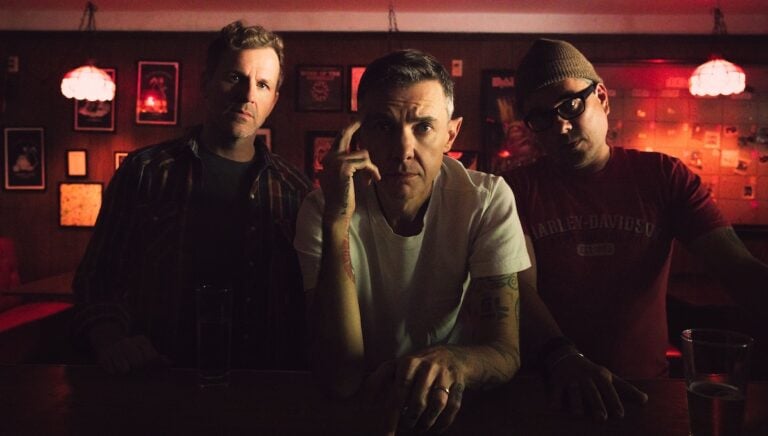

Sparta return this week with Cut a Silhouette, out Friday (May 29th) via Equal Vision & Civilians, their first new album in several years and a record shaped by a renewed sense of purpose.
Produced, engineered and recorded in seven days at Magpie Cage Recording Studio by the iconic J. Robbins, Cut A Silhouette is a collision of past and present. It builds off Sparta’s legacy but equally continues the evolution of a band that has never rested on its laurels.
Ahead of its release, we sat down with guitarist Jim Ward as he reflects on the long road to the album, the creative reset that came from stepping back, and how working with collaborators helped sharpen the band’s identity. He also revisits Sparta’s origins post-At the Drive-In.
Tone Deaf: Let’s talk about Cut a Silhouette. It will be released later this week. It’s Sparta’s first album in a number of years. What made now the right time to release Cut a Silhouette?
Jim Ward: I think we made it in 2019. It came about right when Covid hit, so it’s like the record that never was. Then we made a different record in 2021 which came out in 2022, kind of like our Covid record. I describe that time as if I was going through the valley, figuring out what I’m doing and what I want to do. I’d taken time off the road and had a new perspective.
The real key was when we got Neil Hennessey to start playing drums with us and he just came in with a different perspective. He comes from The Lawrence Arms and he’s like a legend in our community. He’s also a singer-songwriter so he’s not just a drummer. I’ve been lucky to play with guys that are just bigger than drums. Most of my career is with Tony Ajar, who’s a legend.
Love Music?
Get your daily dose of metal, rock, indie, pop, and everything else in between.

We did a couple of legacy tours, like the Wiretap [Scars] tour in Australia and a Porcelain tour. At this age, we’re figuring out where we’re going – are we going to be a legacy band? I’m 49, so do I do the 20, 25, 30, 40-year thing? Honestly, we did it for fans who asked for it and it was a really beautiful experience. The bonus to this was that Neil got to really understand the DNA of Sparta. With his perspective, we were able to come back and make a record that was probably more genuine to what Sparta is than the last two.
The last two were me sort of figuring out what I was doing and pushing some boundaries. And when you push boundaries, you’re not always going to find commercial success, fans are not always going to like it, but that’s okay, right? I don’t make records for any other reason than to put songs on a record, I don’t care about fame or fortune, I’ve never really been part of that game.


Before this record, I went back and listened to all of the records that I loved when I was 15, because we were making a record with J. Robbins. So I wanted to go back and listen to Jawbox’s Grippé and Jawbreaker’s Unfun and all the Fugazi and Quicksand. Just all these things that made me want to be a touring musician. And I got really excited again, I fell in love with music again. And I fell in love with my band.
We made 10 songs, cut it down, wrote more, and refined it until we had a strong crop. Working with J. Robbins was perfect, I felt I already knew how to speak his language musically by just listening to him. It was the right scenario for how and why we do this. I think this is the best record we’ve made in so long. And it’s because of all of that work – years and years and years, five years of downs and outs and ups to get to here.
It sounds like creativity for creativity’s sake.
That’s all I’ve ever done. My whole thing, and I always say this, I’m always just after a better song. Like, can I just write a better song? And I’ve been fortunate to be part of some really great songs, so the bar is pretty fucking high. And I think we delivered on this record. I feel like we did service to the music, and that’s why we called it Cut a Silhouette, because that means ‘leave an impression’. And that’s what I want to do.
You’ve shared a couple of songs from this new album, “Crater” and “Everything You Say” so far. Both really great tracks and don’t necessarily sit in the same place, sonically speaking. There’s quite a contrast there. I hear echoes of a young Bono and early U2 on Everything You Say.
Yeah, probably one of my top five bands ever. And The Clash is also one of my top five bands ever, and U2 is a product of The Clash. So thank you for saying that!
I probably play into that a little because I love U2. I love imagining when we’re making a song in the studio that they’re my older brothers and I can be inspired by them. I’ve been fortunate enough to meet them a couple of times. I’ve definitely taken some of their playbook, as much as I’ve taken from the Fugazi playbook. I’ve always wanted to be that band between Fugazi and U2. I love that grey area. So thank you for saying that. That’s what I’m trying to get to.
Is that contrast between these two singles a fair snapshot of how wide the record is going to stretch sonically?
Yeah. We’ve given listeners a few, but there’s so many more surprises. The other song that I wrote with Frank Iero is called “Mouth Breather”, it’s sort of the weirdest song on the record, and I love it. It dives further into whatever that zone is where you get past the three minute pop song. And it was such a joy to write with him because it really pushed me. And that’s the best part.
What do you think is going to catch people most off guard when they hear the album?
I think it’s the return to energy. I needed to go through that valley to stretch my legs a little bit, and once I learned some new tricks I was able to come back to that energy with Neil and Matt. It’s sort of like I had more tools in my toolbox and they reminded me of that. This band is a beast when it wants to be, and when you got more tools, that beast can get even bigger. I think people will be surprised a little bit. Just reading comments online, people are saying, “Is this like the Porcelain follow-up? Is this the early days coming back?” But it doesn’t sound exactly the same. It’s got some new twists and turns.
Sparta was born out of the disbanding of At the Drive-In. Looking back on it now, do you see forming Sparta as a fresh start or more like unfinished business creatively speaking?
I think it would be neither of those things. We came into this world with a giant chip on our shoulder. The perspective was, “Nobody thinks that these three guys are worth a shit. And we’re going to prove you wrong”.
I’ve got an interesting perspective because I was a guitar player in a band and then became the singer of another band. We made Wiretap Scars with that chip on our shoulder and I wouldn’t change any of that. We had to come out swinging because it was a survival tactic. And I come from a band of survivalists.
At the Drive-In was a band that nobody wanted around until they did. And when they did, we couldn’t hack it. We couldn’t survive that time period. So I’ve always had the mindset of, “I probably don’t belong here.” People may not want me here but I’m going to prove that I belong here.
One thing Neil pointed out early while making this record was, “Sparta was born on a major”. I had never thought about it that way. I never thought that this band was created in this weird vacuum of post At the Drive-In, but we signed to DreamWorks for an incredible amount of money. We got to make this incredible record. But I was never comfortable there.
When I talked to Equal Vision about coming to their label to make this record they asked why I wanted to go to them, and I said “because I want to come home”. That was the biggest moment for me making this record. This is my community and I love being relevant in this community. I couldn’t give a shit about the rest of the world. I don’t need arenas. I love 300-cap rooms, sweaty loud energy-filled rooms. That’s where I want to be. I just want to keep writing songs, be around my people and make good memories.
The beautiful thing about At the Drive-In, and the thing I’ll always be grateful for no matter the interpersonal baggage, is that everybody represented something bigger than themselves. The chemistry of that was incredible. When you separate any of us, it’s not the same, it doesn’t have the same chemistry. But I love that everybody has gone on to make really beautiful, important music. They’ve made incredible records, I think we’ve made incredible records, and when we had the chance to be together, we made something pretty great.
Wiretap Scars is one of those records that people always seem to come back to, why do you think it’s managed to stick around the way that it has?
Again, going back to when you make a record with a chip on your shoulder. We had the fortune of lightning striking multiple times. There’s no reason I should still be doing this. No reason I’ve been able to keep making records, being in bands. I’ve had so many opportunities to do different things and I’m just grateful for all of it.
We don’t get to do this without the fans. If nobody buys your record, you stop making records. That’s reality. So I owe it all to the people who gave enough of a shit to keep buying records and coming to shows.
And I think it fits that moment. We had this angular post-punk sound at a time when people were rapping over rock and wearing masks and stuff. No disrespect to them, but we represented a different trajectory. And there was room for us, which is awesome.
View this post on Instagram
You said this new record has reignited your love for making music. What had started to wear that down for you in the first place?
I don’t think it’s something you can control, whether it’s a person, music, your career, or yourself. Situations come up in life that give you opportunities, and maybe it’s the combination of having Neil and Matt on tour and really enjoying playing music with them.
We’re a very blue-collar band. We tour, we make enough money to live. There’s no frills. You have to really love it to get up, get in a van, drive eight hours, and play to anywhere from 12 to 500 people a night. There’s no consistency to it, so if you’re doing it for the wrong reasons, you’re probably not going to feel great.
What felt good was getting on stage again after a hiatus, seeing friends, and really enjoying playing guitar. From that came, “I want to make new songs”. Now I feel like I’m a better writer, singer, and guitar player than I’ve ever been. I may be missing some notes on the top of my range but I’m finding different ways of expressing that.
How do you plan to celebrate Cut A Silhouette? What are you excited about for the future?
It’s been doing better than we expected. I’m at a point in my life where I can really enjoy it and make the most of it. When I’m in cities I’ve been to 20 times, I get up earlier, go on longer walks, spend more time with fans after shows, and listen to every story I can. I’m grateful for that, because I don’t know how long I get to do this, and I don’t want to waste one fucking second of it. Not one second.
When we talked about press, I said I’ll do everything – every interview, every opportunity. And I will be as exhausted as I’ve ever been at the end of this I hope, because I’m going to take full advantage of it. And I’m going to enjoy every fucking minute.
Sparta’s Cut a Silhouette is out tomorrow, Friday, May 29th. Pre-save/pre-order here.