































The bare brick wall of the Brisbane Powerhouse Theatre, washed in blood-red light, looms above an unassuming instrumentalist.
From his bank of keys and samplers emerge ambient drones augmented by a thrill of synthesized Arabic melodies.
A mystic eastern soundscape fills the room while a crowd of hipsters and hippies alike twitch at the foot of the stage.
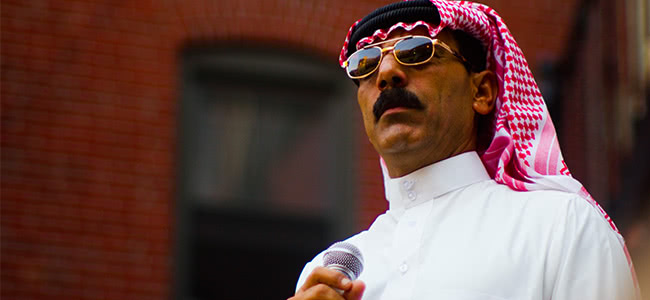
Into this atmosphere walks the unmistakable figure of Omar Souleyman, sporting a moustache that means business—a distinctive presence, undeniably cool in his ankle-length khaki thawb, red keffiyeh, and aviators.
Over the drones of Rizan Sa’id’s keys, Souleyman unleashes his voice, echoing his mawwal-style vocals throughout the room as though they are cascading down from the peaks of Mount Hermon.
Souleyman has lately emerged as a cult hero of world music. He began performing in the mid-90s in his native Syria, largely at weddings and other celebrations.
In 1996, Souleyman teamed up with multi-instrumentalist Rizan Sa’id. The duo drew heavily on western electronica, employing samplers and Arabic-modified synthesizers.
Holding onto traditional Arabic music forms like ataaba (a mixture of poetry and vocals performed at weddings or festivals) and dabke (a traditional Syrian folk dance and party music), the pair added the pounding beats and digital technologies of western dance music.
Quickly becoming a star in Syria, Souleyman’s music attracted the attention of western audiences and musicians. Recently he has collaborated with the likes of Björk and Gorillaz and performed at such festivals as WOMAdelaide, Glastonbury, and the Montreal Jazz Festival.
At the Powerhouse tonight, Souleyman quickly justifies his international reputation.
After the dirge-style vocals of the opening track, Sa’id drops a thumping beat and the crowd immediately begins to bounce. Souleyman, clapping and pacing back and forth across the stage, unleashes a smiling vocal torrent.
His vocals are furious and frenetic, hypnotic high-energy blasts that often work in call-and-response tandem with Sa’id’s phase-shifted keyboard acrobatics.
The vocals, the beats, the breakneck keyboard riffs power on at full speed until the entire room bounces with the vibe of a mythic Syrian nightclub.
At one point Souleyman, microphone tucked under his arm, reaches into the crowd and pulls a guy up on stage, momentarily dancing with him, before plunging back into the hypnotic rhythms of his vocals.
His experience leading countless Syrian festivals is obvious as he buoys up the audience, reaching down for high-fives and handshakes.
His presence however, is unassuming, humble. It is clear that he is there for the people, to ensure that they have fun, and not to assert himself as a performer.
He blows kisses to the crowd and even discourages applause as though he doesn’t deserve it. But he does.
His voice, his demeanour, and his distinctive outfit, mean that you can’t help but love the guy.
That being said, there were a couple of minor problems with the show. The dynamic was simple: loud and fast. Unfortunately, with only two musicians, there was little to break up the sound.
Souleyman has been known to incorporate live percussion as well as other traditional Arabic instruments (such as the saz, ney, and bozouk) into his performances. This range of live instruments would have added a whole other dimension to his performance in terms of dynamic and virtuosity.
Many of the beats, samples, and sounds Sa’id was working with were also quite dated, creating a curious mix of traditional Arabic dance music and mid-90s KLF style house.
But this is merely nit-picking, particularly since he performed for free at the Powerhouse and at GOMA the night before.
Souleyman offers a driving and unique sound, and incomparable stage presence, and a performance that is worth seeing, demands dancing, and feels like a gift from the artist himself.