






























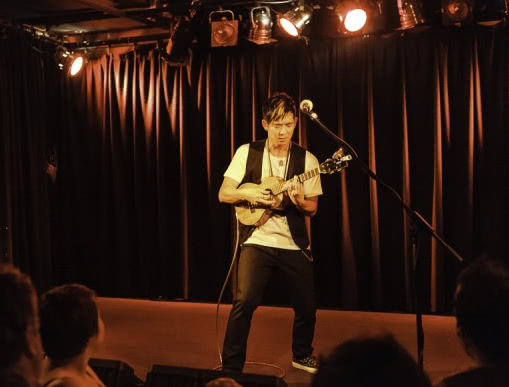

As Jake Shimabukuro walks out in front of the audience, ukulele in hand, he looks a little lonely.
A one-man musical magic act, he stands front and centre on the otherwise empty stage, but when he begins to play, the room falls into a kind of casually awed silence.
He’s a fairly average-seeming guy, who takes to the stage with his instrument and proceeds to instantly knock the socks off anyone who ever thought they knew the sound of a ukulele.
Back in Australia for the third time to play Bluesfest and a string of sideshows, Shimabukuro doesn’t seem to have changed much since his first visit in 2008.
One of the earlier instances of the career-launching powers of YouTube, he still plays a lot of covers, but it’s a welcome novelty offset by charming original songs that are always accompanied by a personal, heartfelt story.
Early on in the set, a cover of Adele’s done-to-death hit “Rolling In The deep” has everyone whispering, ‘wait, what’s this again?’ before realisation dawns.
The tone of the uke morphs with each piece and in this one imitates a mandolin, the picked melody sounding more like traditional Appalachian folk than a Grammy-winning pop song. Shimabukuro covers the vocal line and builds up to a hammering chorus with a ferocity grounded in joy, and the complexity of the sound is astonishing.
It’s the same for a cover of Queen’s “Bohemian Rhapsody” which, when announced, sends a ripple of laughter through the crowd. The near-six minute classic is simultaneously awe-inspiring and a bit of a joke between artist and audience – his rendition is absolutely perfect and yet the self-deprecating facial expressions he pulls during the performance acknowledges that yes, he might be showing off, just a little.
Once again, vocal and instrumental melodies are woven together seamlessly and there’s light and shade that spans the aural distance between 12-string guitar and harp.
His hands become a blur as he builds crescendo after crescendo, culminating in a sickeningly fast shredding to rival a classical guitar virtuoso.
Born and raised in Hawaii, Shimabukuro’s fascination with his instrument began at a very young age, and traditional Hawaiian music has heavily influenced his original work.
Pieces like “Blue Roses Falling” and “Gentle Mandolin” – a new composition influenced by the birth of his seven-month old son – hold great personal significance as well, and he warmly shares the stories behind them with the audience.
While these songs have no lyrics (he gave up singing very early on in his career), a little background information goes a long way towards transforming them into very touching musical fairytales.
The sentimental yet uplifting “Blue Roses Falling” was inspired by a friend’s grandmother, who hallucinated that she saw the titular flowers drifting above as she lay ill in bed.
Shimabukuro’s originals are softer and slightly more delicate, still backed by incredible strength, but with a more controlled sense of energy and emotion. Sliding up the scale at times until the uke sounds exactly like a harp, the music entrancing a silent crowd.
He has a joyous, infectious energy and it’s impossible not to smile along with him as he plays. Announcing one of his final pieces for the night, the cover of George Harrison’s “While My Guitar Gently Weeps” that helped him become a YouTube sensation, he expressed enormous gratitude toward the song that started it all.
It’s an incredible tribute. A tender opening riff opens up to the heart-wrenching chorus where once again, the power of the song is far from diminished by a lack of lyrics.
This version highlights the song’s power, and is played by Shimabukuro with such incredible passion as it morphs into a frenetic, extended ukelele jam, his hands become a blur.
Before he leaves the stage, he adds that he’ll be around to say hello after the show, and begins to play one last piece – a traditional Hawaiian song, and one of the earlier ones he learned to play as a child.
It’s a fitting hark back to his roots and the roots of the uke, and a reminder how far Jake Shimabukuro has exceeded the perceived limits of that little old string instrument.