































“Nice to see you in this large space.”
Willy Mason’s first sentence to an expectedly small opening crowd says much about the dangers of the night ahead. Here are three acts, who haven’t played at an arena before this tour, and would never have previously garnered such expectations as to sell out a 15,000 capacity venue.
But here they were, against all odds, and you could be forgiven for thinking that seeing three folk acts in a much smaller venue would far outweigh the arena atmosphere which often traps live acts into being lacklustre where elsewhere they’d be spectacular.
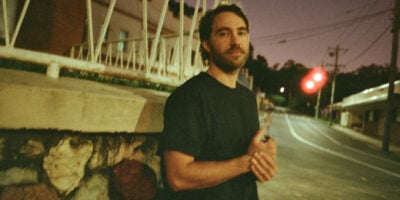
While you can barely judge Mason against such a test given the man is barely whispered about here in comparison to his contemporaries, his talent and bluesy tunes were nothing to shun. But for an audience mostly comprised of teenagers, it was not quite something they were ready for or could fully appreciate.
Having such a large touring group of musicians – that’s not just counting the twelve members of Edward Sharpe & The Magnetic Zeros, but also the extra horn players along for the ride – was something Mason took full advantage of as he brought out some of his “newly made friends” to accompany him. While he was quite capable of filling Rod Laver by himself, the power of a few more instruments in such a setting brought out the best Mason had to offer.
The huge ensemble that is Edward Sharpe & The Magnetic Zeroes last graced us with their presence for the 2011 Big Day Out tour, and nicely not much has changed since then. Alex Ebert was wearing the same simplistic clothing that he wore last time he whistled and bounced his way around stage in Melbourne.
While Edward Sharpe are more than a one man show, Ebert is definitely an exuberant focal point.
Not even halfway through their first song, ‘Man On Fire’, the frontman casually jumps side of stage to high five fans as he made his way up into the seated section.
Though soon mobbed by excitable fans who decided it was necessary to take ‘selfies’ with the singer, Ebert had little trouble making his way back to the stage.
The band’s performance was so lively and joyous that any mention of the word ‘supporting’ was rendered meaningless. They may not have been headlining, but someone forgot to tell them that, as they gave Mumford & Sons a strong showing for best performance of the night.
Not that it’s about a competition at all, with Marcus Mumford joining them on stage for one song, these are two bands who have a fabled history of touring together. The best example though of the exemplary musicianship of Edward Sharpe & The Magnetic Zeroes isn’t the incredible live rendition of ‘Home’, but the decision to play the heartfelt ‘Mayla’ from an audience member’s request.
Little needs to be said about the popularity of Mumford & Sons’ sophomore release Babel or their record sheet to demonstrate how far this folk band has come.
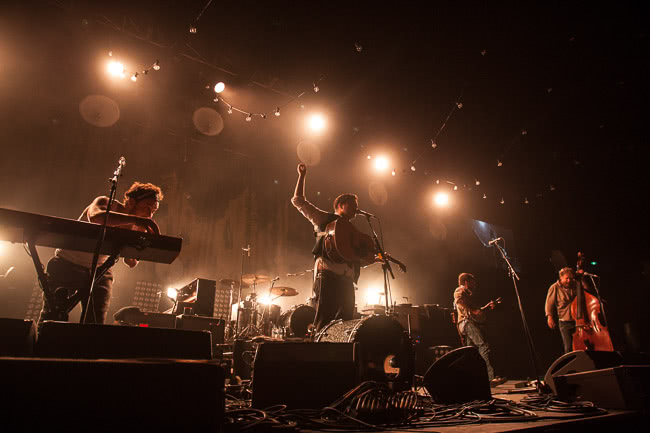
With strings of lights hanging beautifully over the moshpit, the lighting display had the potential to be spectacular, but didn’t fulfil on the promise or the spectacle it had the potential to be.
But with that slight disappointment aside, the live show has always been touted as the English quartet’s best feature. When the band made the smart move of playing ‘Little Lion Man’ second, few could disagree that chills were guaranteed when you combine mass audience participation with their skills.
Whether it be the less lively songs – ‘Awake My Soul’ and ‘Where Are You Now’ – or the thundering drama of ‘Thistle and Weeds’ Mumford & Sons had the talent to easily cast aside any earlier worries.
In fact, the band provides an important lesson in an age of ‘recording artists’ of what it is to put on a live show. While songs from Sigh No More achieved louder cheers as expected, the tracks from their sophomore release were no less enjoyable.
Finishing their encore with a cover of Fleetwood Mac’s ‘The Chain’, the group were joined by the mass of musicians that had played during the night; and if it wasn’t already apparent, the incredible capabilities of this group of people was good enough to entertain any audience in any situation.
More importantly, the all-star closer was a manifestation of the fact that, although this was Mumford & Sons’ headline tour, the night was more about a display of accomplished musicianship than it was your regular arena spectacular.