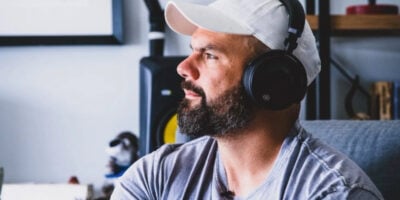































Tone Deaf’s Anaya Latter spoke to Nash Whalen the tousle-headed organ player from psychedelic San Franciscan band Wooden Shjips about simplicity, the sense of the organ, and their new album out on Thrill Jockey, West.
Experiencing the Wooden Shjips live is like stepping into a wormhole. They seem to manage to evoke almost structural soundscapes with their music, something that Nash Whalen says is partially a conscious move to create an experience for the audience.
“We play loud and we play with intensity, so we’re trying to create a certain vibe, and we’re always hoping that it becomes an experience for the people in the audience. If it enables them to trance out, or to dance really hard, however the music is moving them. But that’s what we’re trying to do is just create an intense experience for them.”
Whalen says that behind their textured and intricate wall of sound is a deceptively simple premise.
“When we started the band we wanted to create simple repetitive music. There was a certain element to the early Rock n Roll back in the 50s where people hadn’t really figured out what to do yet. They didn’t even really know how to really amplify their instruments very well. And they weren’t shredding on the guitar or anything either, it was really kinda simple music – compared to today.
And we wanted to kinda go back to that, where every element of the band was starting off from a really simple, identifiable place and from that be able to create a groove that works well in each song and from there we can launch off to wherever.
That’s the main thing when we’re thinking about the music is to create a strong groove that’s really elemental and simple. And I think that that nature of it just grabs people in a way that’s unexpected sometimes. If you tell someone, “oh, we’re just going to play the same thing over and over again,” it doesn’t sound that exciting, but and even though that’s kind of what we’re doing, it ends up there’s so much music beyond that.”
That simplicity, Whalen reveals is refreshing and joyous experience for the members of Wooden Shjips, “keeping everything simple seems to make a huge difference with the way we present our music,” he says.
“I like to tell people about how our drummer Omar, he just plays the bass drum and the snare drum, and a couple of cymbals he hits every now and then. But he doesn’t have all these toms and stuff that normal drummers have. For him, he found it really liberating to strip his drum kit down to the basic elements and just play those – it opened up all these new possibilities for him, with rhythm – just trying to keep it simple as to which drums you’re hitting. The same goes for our bass player Dusty, there’s some songs where he’s just playing a few notes and you know, he really enjoys that.
And that’s part of the reason that people can respond to our music because the parts that we’re playing we really enjoy playing that simple part. It’s one of those intangibles.”
Whalen’s instrument of choice is the organ, which he says makes a lot of sense to him.
“The organ and keyboard is so basic and just makes sense to me. I know how to play it really simply now. So that part of it’s really enjoyable. And there’s also a lot of cool tones that can come out of an organ, it can be a really subtle thing. It doesn’t stand out to the front, but if you listen carefully and hear it you realise it creates a depth to the music that just guitars can’t do. That’s the one thing I enjoy most about it, trying to find different sounds, and being able to add to the overall texture of the music in subtle ways that if it weren’t there, I don’t think our songs would sound as good.”
When it comes to their new record, Whalen reveals it was the first time they recorded in a professional studio, having recorded their prior releases by themselves.
“It [recording West] was [the first time in a studio] – what we did before was we would always record it ourselves in our practice space. We used a 4 track recorder for some of them but also an 8 track, and we just found that a little limiting.
Also, we didn’t have a good selection of mics available to us, and our practice room isn’t necessarily a great sounding room to begin with, so we are certainly proud of our previous releases but we just thought we could make something that sounded better if we were in a better space and had better equipment available to us.
We settled on this space in San Francisco because our engineer Phil Manley worked there and we’d known him a few years, he’d mixed a few of our shows here in San Francisco and we just felt really comfortable working with him.
It really made a difference to us, because we didn’t have to worry about setting the levels, and pushing record and all those things that an engineer does, and that really freed us up to concentrate on our playing and making the music that we wanted to make.
For me, it took a lot of that uncertainty and stress about it that just all disappeared with working in an actual recording studio and I think that comes through on the album, besides it just sounding a little better, and there being more space in the songs from the way it was recorded, the way that we played was just much more comfortable for us.”
In terms of themes, Whalen cites that a range of musical and geographical influences pepper West. “The Western US – there’s lots of different pockets of music that have come out of here, whether it’s the Bakersfield sound and country music or the San Francisco sound of the 60s or the punk scenes of southern California and I think we’ve managed to capture different elements of that in the way the music is presented.”
Wooden Shjips, both in their live presence and from the music they create give a sense of being intuitive and relaxed, and Whalen reveals that their creative process is an easy and collaborative one.
“I think it really is very organic, when we’re working out our songs – I don’t know I can just imagine other bands getting really wrapped up in when the cymbal hit should come or when the lyrics should start or end and that doesn’t really happen for us.
When we’re working out a song we’ll sit there and just start playing and sometimes we’ll just play for a half an hour or 40 minutes at a time, just playing the song and trying out different elements to it. When we’re done we won’t sit there and analyse it, it’s just not in our natures to want to do that.”
Whalen reveals that the songs have their own lives to some extent, but that is all part of their enjoyment and experience of playing.
“When it’s live it’s different every time, one of us might forget something or something we’ve done before might not quite happen in the same way. It doesn’t throw us off because we feel like theses songs can have their own life every time we play them. They always change in that way.
Especially when we’re playing live we definitely feed off the audience, if the audience is a dancing crowd, we might play our songs faster that night or keep it going longer to let the people keep moving to that part they seem to really enjoy or whatever. Nothing is set in stone. We try to know how the song will start, at least, but where it ends is almost always a mystery.”
Mysterious ends are a Wooden Shjips specialty, and their new album West is a soundscape tapestry worth wrapping your ears and mind around.
Wooden Shjips guitarist Ripley Johnson’s side project Moon Duo is in town and will be playing a round of shows:
Melbourne: 28th September, Northcote Social Club.
Sydney: 29th September, Oxford Arts Factory.
Brisbane: 1st October, Woodland Bar.