























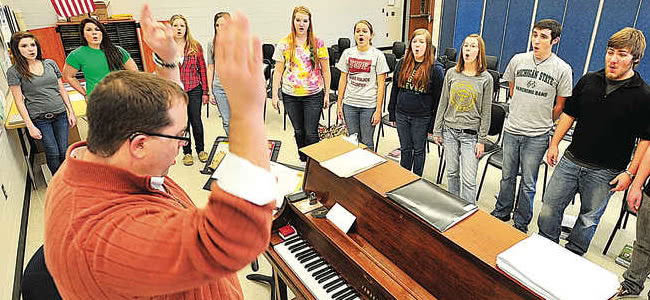

As previously reported, last month 600,000 Australian school students banded together with support from high profile musicians, and even Education Minister Peter Garrett, in the hopes of drawing awareness to the lack of well-funded, detailed music education programs in school curriculums across Australia.
In multiple Australia-wide demonstrations organised by Music: Count Us In, a non-profit organisation that aims to raise the profile of music education throughout the country, students from private and public schools across the country – in both rural and urban areas, sang their rendition of Josh Pyke’s song “Different People (Stand Together)” as a symbolic gesture to raise an issue that’s been lacking in national profile.
It seems to have begun to set the wheels in motion with news from The Age that Victoria is organising an inquiry into music education programs of schools across the state.
The Victorian Parliament’s education and training committee are spearheading the inquiry, which seeks to examine the quality of music education taught at primary and secondary level and how funding arrangements are in place and function for music programs.
”It seems as though at the moment there is a fair bit offered at the secondary level but not as much at the primary level,” said chairman David Southwick. Telling the ABC: “We want to know why kids aren’t taking music programs, why there isn’t more being offered and how we can get more young kids involved in music programs.”
“We know that many of the world’s top performing academic countries have strong music programs,” stated Mr Southwick. “The Committee wants to ensure that Victoria doesn’t lag behind these countries in realising the benefits and potential of music education for our children and young people.”
“Overwhelmingly, the two most common reasons for not running a (music) program were insufficient budget and lack of … appropriate staff.”– Jennifer Heinrich, Researcher
The 2007 Gonski report revealed an alarming statistic showing that just 23% of government schools are able to provide students a meaningful music education, while The Age points out that 80% of schools in NSW have no classroom music education whatsoever, likewise, more recent research into this year found also found that 38% of rural Victorian primary schools lack a music program.
Researcher Jennifer Heinrich told the paper that “overwhelmingly, the two most common reasons for not running a program were insufficient budget and lack of … appropriate staff.”
Dr Anne Lierse, a fellow researcher and spokeswoman for the School Music Action Group, said that the music education was severely lacking in metropolitan Melbourne. Dr Lierse’s own survey results at Melbourne High, where she teaches piano, showed that 66% of new students had no music education at their primary school.
Dr Lierse’s findings also indicated a huge gulf between school systems, pointing to the recent Music Council of Australia survey which concluded that 88% of independent schools had music programs compared with 35% of state schools.
Dr Lierse reasons that the lack of music education in Victorian schools has never recovered from budget cuts in the 1990s, which led to around half of the state’s secondary schools, and a larger portion of primary schools forced to cut back – or completely remove – their music programs.
There are also concerns from education bodies that music education is being cannibalised by preparation for the National Assessment Program – Literacy and Numeracy (NAPLAN) tests. A study from the University of Melbourne released last week found that 69% of educators – drawn from nearly 8,353 teachers – said that NAPLAN led to a reduction in time spent on other programs.
Victorian Opera music director Richard Gill added his voice to the chorus of those concerned, stressing the importance of music as part of a broader education, noting that NAPLAN testing had stilted creativity.
“NAPLAN is a national disgrace,” Gill tells ABC, “the money that’s being spent on that could be used to teach teachers how to teach music or to get music into schools in a serious way.”
“Music is the primacy of all learning, based on the fact that music enhances a child’s capacity to concentrate, focus and listen more than any other subject,” says Gill. “My view is music should come first because, apart from all the reasons we know it is good to teach music, it has an impact on all other learning.”
The national statistics and protests from banding schools demonstrates that would-be musicians aren’t getting the proper exposure they need to music through the education system, and with the lack of primary school music education, aren’t getting exposed to music from a young age. The result of which could mean that the chances of Australia producing more quality musicians will diminish.
At a state level, the Victorian Government has shown its support for engendering youth-orientated music programs and events after injecting $2.4 million into FReeZA, a state youth music program that hosts live shows, underage events, and workshops. But Australia wide, it’s the Federal Government charged with improving the presence of music education in Australian Schools, and that task falls to none other than the former frontman of Midnight Oil, Peter Garrett.
The Minister for School Education, Early Childhood and Youth has spoken before about the importance of music in the school curriculum, including a 2011 speech to a NSW high school on the subject, as well as showing his support by counting down the performance of Music: Count Us In with 1,800 kids from ACT schools in front of Canberra’s Parliament House, reports Street Corner.
Hopefully, the musician turned politician can find the necessary power and the passion to reinvigorate the school system and its ailing lack of music education.