































When Iron Maiden first set foot in Australia in November 1982, they were still hungry young outsiders playing Sydney’s Capitol Theatre to a crowd of around 2,000 people.
Four decades on, they’re returning to headline outdoor stadiums in Melbourne and Sydney for the first time in their 50-year history. It’s a full-circle moment that feels less like nostalgia and more like a victory lap that never really ended.
This November run — their eighth Australian tour — is already shaping up as the most ambitious they’ve mounted here. Stadium shows in Melbourne and Sydney will sit alongside arena dates in Adelaide and Brisbane, all featuring fellow thrash titans Megadeth as special guests. It’s a pairing that reads like a fantasy festival bill, except this one is real, and confined to one colossal night in each city.
Promoter Paul Dainty has called it the band’s biggest Australian tour ever, and it’s hard to argue. Maiden have long been a guaranteed arena act in this country, but stepping into stadium territory marks a new chapter. For a band that has spent five decades refining its live show into something closer to theatre than a gig, the scale feels appropriate.
“Everything you need to know about Iron Maiden is onstage,” frontman Bruce Dickinson once said. It’s a line that still rings true. Maiden’s legend hasn’t been built on mystique or tabloid myth-making; it’s been built on spectacle, precision, and sheer stamina. Over 17 studio albums, more than 100 million records sold, and nearly 2,500 shows across 64 countries, they’ve forged a reputation for performances that feel like endurance tests, for band and audience alike.
View this post on InstagramLove Music?
Get your daily dose of metal, rock, indie, pop, and everything else in between.

The current lineup — Dickinson alongside guitarists Janick Gers, Adrian Smith and Dave Murray, bassist and founder Steve Harris, and drummer Simon Dawson — is a well-oiled machine. Harris, the band’s primary songwriter and driving force, has spoken warmly about bringing Megadeth out for this run, noting that the longstanding friendship between himself and Megadeth’s Dave Mustaine adds another layer of meaning to the tour.
Megadeth, who recently scored a number one album in both Australia and the US with their self-titled final studio record, are currently on their final-ever world tour. That makes this double bill more than just a strong support slot; it’s a rare convergence of two metal institutions at pivotal moments in their respective stories. One band celebrating half a century at the top. The other taking a final bow.
For Australian fans, the setlist alone is reason enough to show up early and stay late. Maiden have promised a career-spanning show that reaches back to their earliest days and barrels through the decades: “Hallowed Be Thy Name”, “Run To The Hills”, “Phantom of the Opera”, “The Trooper”, “The Number of the Beast”, “Killers”, “Powerslave”, “2 Minutes to Midnight”, “Rime of the Ancient Mariner”, and “Seventh Son of a Seventh Son”. These aren’t just songs; they’re rites of passage for generations of fans who first found metal in a suburban bedroom, a borrowed CD, or a battered patch stitched onto a denim jacket.


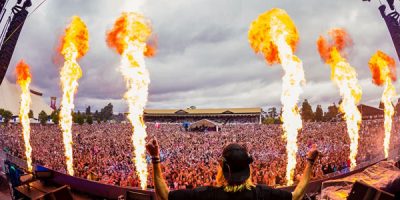
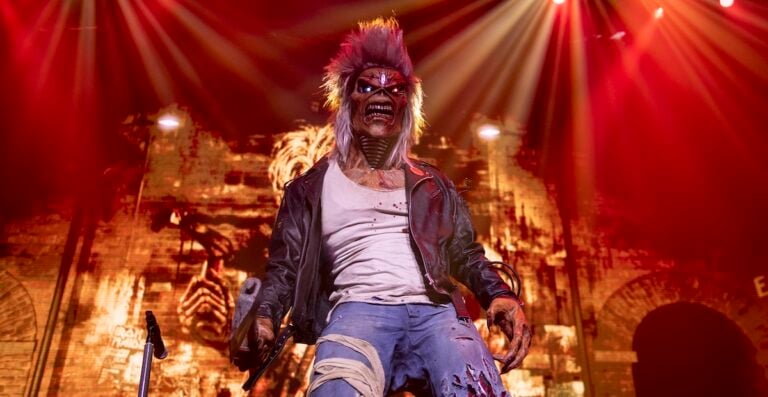
There’s also the matter of scale. Maiden’s live shows have always been defined by elaborate stage sets, pyrotechnics, shifting backdrops and, of course, their ever-present mascot Eddie: looming, stalking, sometimes towering over the band in monstrous form. In stadiums, that production will only grow more imposing. It’s the kind of show that demands to be seen in person: bigger screens, higher flames, louder singalongs, and tens of thousands of voices rising as one when Dickinson hits the chorus of “Fear of the Dark”.
The timing of the tour also dovetails neatly with another major moment in the Maiden story. This May, Australian cinemas will screen Iron Maiden: Burning Ambition, a new documentary directed by Malcolm Venville and produced by Dominic Freeman. Featuring reflections from the band as well as admirers like Javier Bardem, Lars Ulrich and Chuck D, the film charts the group’s five-decade ascent, weaving rare archival footage with new animated sequences starring Eddie. For fans, it’s both a history lesson and a reminder of just how far the band have travelled, both geographically and culturally.
Watching that documentary in a cinema, then seeing the band command a stadium months later, will underline the simple fact that Maiden have never slowed down long enough to become a heritage act. Even as they edge further into legend status, there’s no sense of a group coasting on reputation. Dickinson’s famously combative bravado — he once quipped that they were “better musicians, better players” than their counterparts — has always been matched by a work ethic to back it up.
What makes this Australian tour feel especially significant is the context. When Maiden first arrived here in the early ’80s, heavy metal was still carving out its place in the mainstream. Now, decades later, they’re headlining stadiums in cities where they once fought for space on the margins. It’s a testament not just to their own staying power, but to the loyalty of Australian fans who have grown older alongside them, passing the music down through families and friend groups.
View this post on Instagram
Harris has said the band are excited to bring this show down under, promising something “even more memorable” with Megadeth in tow. For a group that has built its name on excess — in volume, in scale, and in ambition — that’s saying something.
This November, Iron Maiden won’t just be revisiting Australia. They’ll be claiming their largest stages yet, backed by five decades of songs that refuse to age and a fanbase that refuses to fade.
For those who have been there since 1982, and for those discovering the band through a documentary screening or a streaming playlist, the message is the same: if you want to understand Iron Maiden, don’t just read about them. Stand in the crowd, look up at the lights, and let the show speak for itself.