






























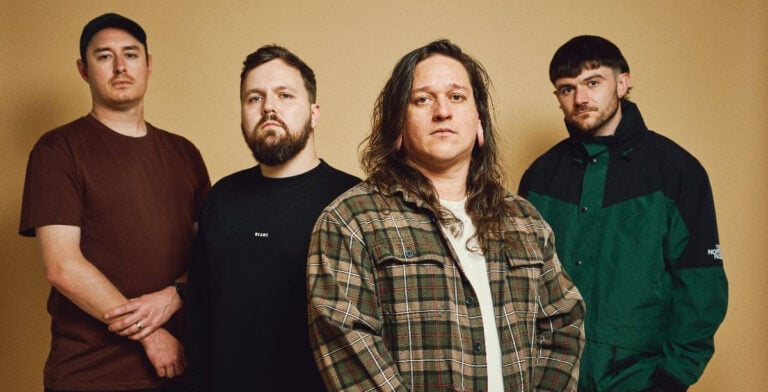

For the average heavy music devotee, the “standard” gig environment is familiar territory: low ceilings, sticky floors, and the inescapable scent of sweat and beer. It’s a world cloaked in darkness, where the outside disappears for ninety minutes of cathartic chaos. This Saturday (February 14th), Sydney metalcore heavyweights Polaris are throwing that script out entirely.
Instead of another packed, dimly lit room, the band will take over St Kilda’s Riviera Beach Club for their curated festival Life’s A Beach, trading sweaty basements for salt air, open skies, and ocean views. As guitarist Jake Steinhauser puts it, “It’s about as far away as you can get” from the rooms they grew up playing.
It’s a bold experiment in contrast: emotionally intense music performed in broad daylight, with Melbourne’s coastline as the backdrop. And according to Polaris, it’s an experience that hits differently.
Despite the scale of the event, Life’s A Beach wasn’t the result of some long-term branding exercise. It came together through serendipitous timing.
“Our booking agent had the space available and came to us and said, ‘Is this something you guys would be keen on?’” Steinhauser explains. “He did sort of brainchild the idea from the very beginning.”
The pitch immediately clicked. Polaris had previously played an outdoor big top show in Victoria and loved the energy, but a full-scale beachside festival felt like something rarer.
“You do spend a lot of time in venues,” he says. “Some of them are spectacular, but sometimes they can just start to feel quite the same. Outdoor fests are great, but outdoor fest by the beach? Rarer even still.”
Love Music?
Get your daily dose of metal, rock, indie, pop, and everything else in between.

View this post on Instagram
Rather than forcing their usual set into a new setting, the band embraced the shift. “We’re trying to curate the set around that kind of vibe,” Steinhauser says. “Hopefully we can bring in that sunny sort of energy into the show.”
Featuring acts like We Came As Romans, Caskets, and late addition HEAVENSGATE, the Life’s A Beach lineup feels less like a legacy package and more like a snapshot of where heavy music is right now. For Polaris, that was deliberate.
“When you’re staring at something and it finally has that last band, it all starts to look balanced,” Steinhauser explains. “You realise, okay, that looks like a full package.”
The band prioritise mixed bills and adjacent genres, something that reflects their own musical DNA. “We love all of the adjacent genres and sounds,” Steinhauser says. “We tend to borrow from them ourselves.”
They’re also deeply invested in supporting rising acts with genuine momentum.
“We try to have our ears to the ground,” he adds. “Not just bands doing well online, but bands where you’re hearing their shows are going well. There’s an energy.”
That raw excitement, he says, often comes from artists just starting to break through. “People feel like they’ve discovered something for the first time.”
That mindset reflects Steinhauser’s broader view of the current Australian heavy scene. “It’s a lot more diverse,” he says. “When we were starting out, there was a more homogenous nature.”
Back then, many local bands were learning together, playing similar breakdown-heavy styles. Now, he sees artists taking bigger creative risks. “There’s a lot of bands pulling from more diverse places. I’m coming across more and more bands where I’m like, ‘You’re just doing your own thing.’ That’s exciting.”
Life’s A Beach feels like an extension of that philosophy, a festival that reflects evolution rather than nostalgia.
The event also serves as one of the final celebrations of Fatalism, Polaris’ 2023 album that debuted atop the ARIA charts and propelled them onto major stages in Europe and the US.
Looking back, Steinhauser describes the record as deeply tied to its circumstances.
“We wrote that one in lockdown,” he says. “It’s probably a gloomier record.”
It’s also inseparable from the loss of guitarist Ryan Siew, who passed away in 2023. That emotional weight has shaped how the band reflects on the era.
“You spend so much time with these songs,” Steinhauser says. “Then suddenly three years have gone by and they’ve taken on all this extra meaning.”
Now, as Polaris prepare new material, some Fatalism tracks will be temporarily shelved.
“I adore playing ‘With Regards’,” he admits. “‘Dissipate’ has been a lot of fun.” But rotating songs out is part of growth. “It’s the joy of moving through your band’s history.”
While touring remains relentless, Polaris are already deep into their next chapter, and Jake says the creative approach has shifted. “We’ve tried to give ourselves the time,” he explains. “Not to force it.”
Where Fatalism leaned into darker, heavier moods, the new material returns to what the band sees as one of their core strengths.
“Beautiful sad,” Steinhauser laughs. “We’re big fans of writing pretty music with sad lyrics.”


This time around, they’ve also tried to be gentler with themselves.
“We decided to allow ourselves a bit of grace,” he says. “Let it be constructive and healing, rather than extraordinarily difficult.” That change has paid off. “The music feels diverse for us. I’m really proud.”
Soon after Life’s A Beach, Polaris will support Linkin Park’s Australian tour — an opportunity Steinhauser still finds surreal.
“I would’ve been about 12 when I picked up Meteora,” he recalls. “They were metal music for the masses.”
Hearing heavy music alongside pop songs on the radio changed everything for him. “Their DNA is in so many of the bands I’ve listened to since.”
When the tour opportunity emerged, Polaris went all in. “We really wanted it,” Steinhauser admits. “We submitted ourselves and crossed our fingers.”
Landing the slot feels like completing a circle that started in childhood bedrooms and car radios.
Behind the success, Polaris has been open about prioritising mental health.
“We’ve even begun doing band therapy,” Steinhauser says. “I advise it for any group that works together this long.”
Constant travel takes its toll, and the emotional intensity of their music only amplifies that.
“Being on stage is a way to get energy out,” he explains. “In the studio, it’s more logic and brain power. But there’s a rush when things click.”
For Steinhauser, creating together has become a source of healing. “[We’ve been] getting a sense of purpose through that, it’s been really good,” he says.
So is Life’s A Beach just a clever name, or something deeper? “It’s snappy,” Steinhauser laughs. “It’s got a bit of tongue-in-cheek.”
But it also reflects where Polaris are now: still heavy, still intense, but learning to balance ambition with sustainability.
As younger bands increasingly look to them the way they once looked to Parkway Drive, Steinhauser admits it takes conscious effort to recognise how far they’ve come.
“You get tunnel vision,” he says. “You’ve got to stop and go, ‘How cool is that? We just did that.’”
Tickets for Life’s A Beach are available here.